Ask most people to picture “dieting,” and they’ll imagine calorie counting, forbidden foods, and constant restriction. Yet in France a country famous for buttery croissants, long cheese boards, and wine with dinner; obesity rates remain significantly lower than in many other Western countries. This isn’t a paradox as much as it is a philosophy: the French don’t diet. They eat differently, and it works. If you want to lose weight without dieting, the French approach offers something rare: a sustainable, pleasure-based relationship with food that naturally supports a healthy weight without ever feeling like deprivation.
The “French Paradox”: Why Food Culture Matters More Than Food Rules
The term “French Paradox” was coined to describe a curious observation: despite a diet rich in saturated fats, cheese, butter, and wine, the French have historically had lower rates of heart disease and obesity than many other Western nations. While researchers have debated the exact causes, most agree it isn’t about what the French eat as much as how they eat.
This is the heart of the French approach to weight management it’s not about eliminating rich or indulgent foods. It’s about the structure, pace, and mindset around eating that naturally prevents overconsumption.
1. Quality Over Quantity
In French food culture, a small amount of something excellent is preferred over a large amount of something mediocre. A thin slice of a truly good cheese, a few squares of dark chocolate, or a modest portion of a rich sauce the goal is savouring, not filling up.
This mindset naturally reduces overall intake. When food is genuinely satisfying, smaller portions feel like enough, which removes the psychological “diet” feeling of restriction.
Practical tip to lose Weight Without Dieting
Before buying packaged or low-quality versions of a food you love, invest in a smaller amount of the real, high-quality version. You’ll likely eat less and enjoy it more.
2. Structured Meals, Minimal Snacking
Unlike the grazing culture common in many English-speaking countries, French eating habits are built around three defined meals, eaten at consistent times, with minimal snacking in between. This structure allows the body’s natural hunger and fullness signals to reset between meals, rather than staying in a constant, low-grade “always eating” state.
This doesn’t mean starving between meals, it means trusting genuine hunger rather than reaching for food out of boredom, stress, or habit.
3. Eating Slowly, and Without Distraction
A French meal is rarely eaten standing up, in a car, or in front of a screen. Meals are treated as an experience, often a social one, which naturally slows down the pace of eating.
Eating slowly gives your brain time to register fullness (a process that can take up to 20 minutes), which reduces the likelihood of overeating. It’s a simple, no-effort form of mindful eating that requires no calorie app or food journal, just presence.
Practical tip:
Try eating one meal a day without your phone nearby. Notice how much more attuned you become to your actual hunger and fullness.
4. Portion Control Without Measuring
French portions, particularly at home, tend to be smaller than the oversized servings common elsewhere, but this isn’t achieved through rigid measuring or calorie counting. Instead, it comes from cultural norms: smaller plates, multi-course meals that pace out the eating experience, and an expectation that seconds are the exception, not the rule.
This approach removes the mental burden of “diet math” while still naturally moderating intake.
5. Walking Is Built Into Daily Life
In many French cities and towns, walking to the bakery, the market, or work is simply part of daily routine, not a scheduled “workout.” This incidental movement adds up over a day without requiring structured exercise, and it plays a meaningful role in the lower rates of sedentary, related weight gain seen in more walkable regions.
Practical tip:
Look for small opportunities to walk more in your own routine to the shop, around the block after dinner, or during a phone call rather than relying solely on scheduled workouts.
6. No Food Is “Forbidden” : a powerful tool to lose weight without dieting
Perhaps the most important cultural difference: in French food culture, no food carries moral weight. Bread, butter, cheese, and wine are not “bad” foods to feel guilty about. They’re simply part of a balanced way of eating, enjoyed in reasonable amounts.
This absence of guilt is significant. Research on restrictive dieting consistently shows that labelling foods as “forbidden” increases cravings and the likelihood of binge eating. By removing that moral framing, the French approach sidesteps one of the biggest psychological traps of traditional dieting.
7. Fresh, Seasonal Ingredients Take Priority
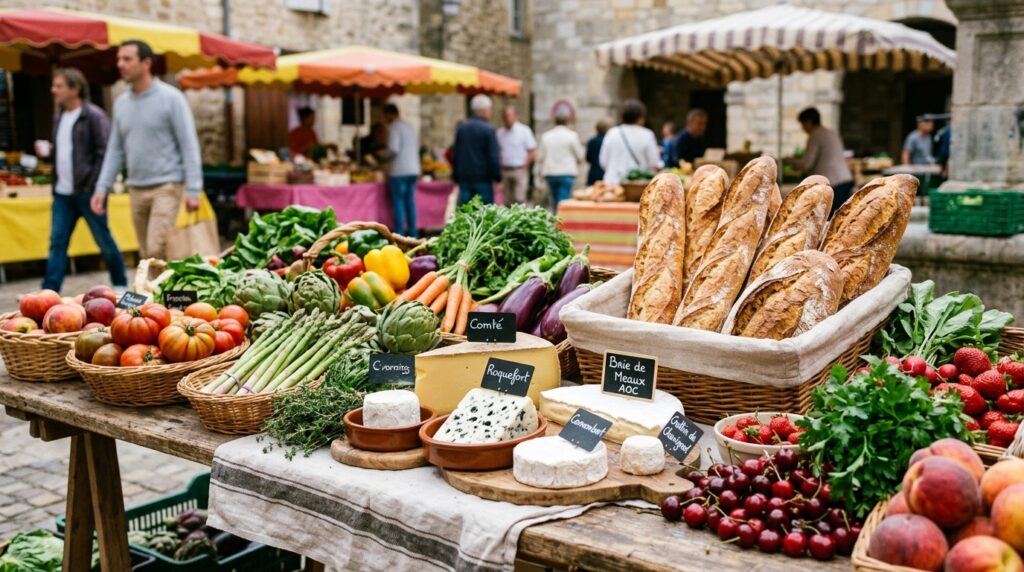
French cuisine places a strong emphasis on fresh produce, quality proteins, and seasonal ingredients often sourced from local markets rather than pre-packaged and processed foods. Meals are frequently built around vegetables, with rich or indulgent elements (butter, cheese, sauces) used to enhance rather than dominate the plate.
This naturally increases fibre and nutrient intake while keeping overly processed, calorie-dense foods to a smaller share of the diet without ever framing it as a restriction. That is how the French don’t get fat and can lose weight without dieting.
8. Wine and Food, in Moderation
Wine is often part of a French meal, but typically in modest amounts and always alongside food, not as a separate habit. This pairing supports slower eating and portion awareness, while the cultural norm of moderation (rather than abstinence or excess) keeps overall intake in check.
(If you don’t drink alcohol, this principle can simply be set aside, the surrounding habits around structured, mindful meals matter far more than the wine itself.)
Bringing the French Approach Into Your Own Routine
You don’t need to live in Paris to eat like the French. The core principles can be adapted anywhere:
- Choose quality over quantity, especially with indulgent foods
- Eat at consistent meal times, and minimize mindless snacking
- Slow down : eat without screens when possible
- Let smaller plates and multi-course structure guide natural portion control
- Walk more as part of daily life, not just as scheduled exercise
- Remove moral labels from food, nothing is “good” or “bad”
- Prioritize fresh, seasonal ingredients over processed convenience foods
None of these require calorie counting, meal plans, or willpower in the traditional sense. They work because they reshape your relationship with food, which is ultimately what makes weight loss without dieting sustainable.