

The Mediterranean diet is one of the most thoroughly studied diets. It is consistently the most effective ways to eat to protect your heart, your brain, your waistline, and your long-term health.
This guide covers everything you need to actually understand and start the Mediterranean diet. What it is ? where it came from exactly ? Which foods to eat and avoid. What the research says about its benefits (including weight loss). A sample day of eating, and a practical, step-by-step way to begin introducing some of its principles in your diet.
What Is the Mediterranean Diet?
The Mediterranean diet is a traditional way of eating inspired by the food habits and lifestyle of people living around the Mediterranean Sea, particularly in countries and regions such as Greece, Italy, Spain, southern France, Crete, Cyprus, Croatia, and parts of North Africa, including Morocco.
More than a diet, it is best described as an eating pattern: a simple way of building meals around minimally processed foods, plenty of plant foods, healthy fats, and moderate amounts of animal foods. It reflects traditional Mediterranean food culture, where meals are based largely on vegetables, fruits, whole grains, legumes, nuts, seeds, and olive oil, with fish, seafood, eggs, dairy, poultry, and meat included in varying amounts.
The Mediterranean diet is not a restrictive . It is a flexible way of eating to follow for life. There is no need to count calories, eliminate entire food groups, or follow a strict macro-nutrient ratio. Instead, the focus is on food quality, balance, variety, portion awareness, and enjoying meals without unnecessary restriction.
In short: eat plenty of vegetables, fruits, whole grains, legumes, nuts, seeds, and olive oil; include fish and seafood regularly; enjoy eggs, dairy, and poultry in moderate amounts; eat red meat less often; and keep ultra processed foods, sugary foods, and other less nutritious foods as occasional choices rather than everyday staples.
The Mediterranean diet is ultimately about how you eat consistently, not about following a perfect set of rules. It combines nourishing foods with pleasure, social meals, and a relaxed approach to eating making it less of a “diet” and more of a sustainable lifestyle.
A Brief History: Where the Mediterranean Diet Came From
In the 1950s and 60s, physiologist Ancel Keys led the landmark Seven Countries Study, which tracked diet and heart disease across populations in the U.S., Japan, and several Mediterranean countries. Keys and his colleagues noticed something striking: people in places like Crete and southern Italy had dramatically lower rates of heart disease than Americans, despite diets that were, in some cases, relatively high in fat just a different kind of fat, coming mostly from olive oil rather than butter and animal fat.
The Mediterranean diet wasn’t invented by a nutritionist or a wellness brand, it emerged from observation. In the 1950s and 60s, physiologist.
Today, the Mediterranean diet is one of the most researched dietary patterns in existence.
In 2010 UNESCO added the Mediterranean diet to its list of Intangible Cultural Heritage, recognising it as a cultural practice as much as a nutritional one.
The Core Principles of the Mediterranean Diet
before getting into the food pyramid, it is important to understand first the underlying philosophy. These are the principles that hold the whole pattern together :
1- Plants form the base of every meal
Vegetables, fruits, whole grains, and legumes are the main dishes. They make the majority of what’s on the plate.
2- Olive oil has the lion share when it comes to fat
Extra virgin olive oil is the primary source of added fat. Margarine and other refined fats are off the table.
3- In the Mediterranean diet : fat is not the enemy
In fact, what matters is the type of fat: the good fat. It embraces : nuts, seeds, fish, olive oil. They are monounsaturated and polyunsaturated fats. They are linked to better cardiovascular health.
4- Fish and seafood are the preferred
Access to the sea naturally made fish and sea food an important part of the diet. It includes sea products at least twice a week.
5- Animal protein is not the master piece
Poultry, eggs, and dairy (particularly yogurt and cheese) appear in moderate amounts, regular but not daily at every meal. Red meat has an occasional, smaller role.
6- Minimally processed foods are the norm
Whole grains and other minimally processed foods are the norm. Refined and highly processed foods are eaten less often, while fresh, whole foods make up the foundation of the Mediterranean diet.
7- Herbs and spices do the flavouring
Garlic, oregano, rosemary, basil, and other herbs are used generously in place of heavy salting.
8- Meals are a social event
Eating together is not reserved for special occasions. Ideally, meals are a daily part of family life. People organise their day around meals rather than fitting meals into whatever time is left. Lunch is sacred, you don’t eat it on your desk or on the go. In France for example lunch breaks are an institution: you sit down, take your time and eat with your friends, family or colleagues.
Meals are not just about food. They are an opportunity to connect, talk, laugh, and simply enjoy being together. The focus shifts away from food itself and towards the experience of sharing a meal. You get satisfaction not only from what is on your plate, but also from the quality of the conversation, the company, and the moment you share.
9- Movement is embedded in the daily routine
Not necessarily sport, but movement: walking, gardening, household chores, manual work, taking the stairs, or simply being on your feet throughout the day.
Traditional Mediterranean lifestyles naturally involve a lot of physical activity as part of everyday life. People walk to the shops instead of taking the car, work in their gardens, do things by hand, and spend less time sitting for long periods.
The Mediterranean Diet Food Pyramid
The Mediterranean Diet Pyramid organises foods from daily staples at the base to occasional foods at the top.
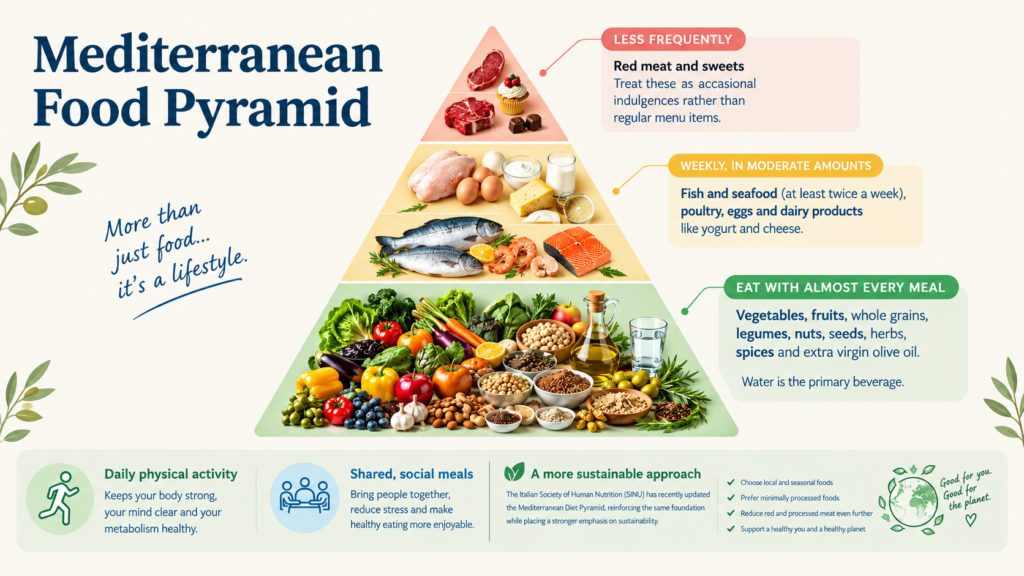
Foods to Eat on the Mediterranean Diet
Fruits and Vegetables
Several servings daily following the seasons : Leafy greens (spinach, kale, arugula), tomatoes, cucumbers, peppers, aubergines, potatoes, courgettes, onions, garlic, carrots, artichokes, and broccoli. Apples, oranges, grapes, figs, dates, pomegranates, melon, berries, and stone fruits like peaches and apricots.
Whole Grains
The traditional Mediterranean diet includes whole-wheat bread and pasta, bulgur, farro, barley, brown rice, oats, and polenta as everyday staples.
Legumes
Legumes sit at the base of the Mediterranean food pyramid and can be enjoyed several times a week. Lentils, chickpeas, white beans, fava beans, and black-eyed peas are excellent sources of plant protein and fibre.
Nuts and Seeds
A small handful almost every day : Almonds, walnuts, pistachios, pine nuts, sesame seeds, and flaxseeds.
Healthy Fats
Olives and olive oil are used almost every day as the main sources of added fat, both for cooking and dressing.
Fish and Seafood
At least twice a week: Choose fish and seafood such as sardines, anchovies, mackerel, tuna, mussels, shrimp, squid and other locally available varieties. Focus especially on small oily fish like sardines, anchovies and mackerel, which provide plenty of omega-3 fatty acids.
Poultry, Eggs, and Dairy
Eggs and poultry such as chicken and turkey appear a few times a week rather than every day. Dairy usually in modest portions of natural yogurt, Greek yogurt or traditional cheeses such as feta, mozzarella …
Herbs and Spices
Basil, oregano, rosemary, thyme, mint, cinnamon, cumin and garlic add plenty of flavour without relying heavily on salt.
Beverages
Water is the default beverage. Coffee and tea are part of the daily consumption with moderation. Wine was traditionally enjoyed with meals in many Mediterranean cultures but some Mediterranean cultures don’t drink alcohol. Wine is not a necessary part of the Mediterranean diet. If you already drink alcohol, keep it occasional and moderate; if you do not drink, there is no reason to start for health benefits.
Foods to Limit or Avoid on the Mediterranean Diet
The Mediterranean diet doesn’t eliminate entire food groups. Instead a few categories are meant to stay occasional and in smaller amounts:
- Red meat
- Processed meats
- Refined grains
- Added sugars and sweets
- Highly processed and packaged foods
- Butter and refined oils
The traditional Mediterranean diet does not strictly restrict or eliminate these foods, but it does consume them less often.
Health Benefits of the Mediterranean Diet
The Med diet is the most studied and thoughtfully researched diet in the world. The health benefits that are associated with this eating pattern are:
Heart Health
This is one of the areas where the Mediterranean diet has the strongest scientific evidence. In the large PREDIMED trial, researchers followed more than 7,400 adults in Spain who had a high risk of cardiovascular disease. They found that people following a Mediterranean diet enriched with extra-virgin olive oil or nuts experienced fewer major cardiovascular events than those following a reduced-fat diet. After researchers reanalysed the study because of problems with the original randomisation, the results remained similar, with around a 30% lower relative risk in the Mediterranean-diet groups.
Beyond this trial, research consistently links a Mediterranean-style eating pattern with several markers of better cardiovascular health. Studies have associated greater adherence with healthier blood pressure, blood sugar regulation and metabolic health. Together, these findings help explain why the Mediterranean diet remains one of the most studied dietary patterns for heart health.
Blood Sugar and Diabetes Prevention
The more recent PREDIMED-Plus trial, which added calorie control and physical activity to the traditional Mediterranean pattern, found this combined approach reduced the risk of developing type 2 diabetes by 31%. One of the largest nutrition trials ever conducted in Europe.
Brain Health
Multiple studies have linked higher adherence to the Mediterranean diet with a reduced risk of cognitive decline and dementia. One large study found an association between Mediterranean-style eating and a meaningfully lower likelihood of impaired brain function over a four-year follow-up period, and researchers have pointed to the combination of nutrients from fatty fish, whole grains, nuts, and produce as working together to support brain ageing.
Longevity
The Mediterranean diet may also support a longer, healthier life. Large population studies have found that people who follow the Mediterranean pattern more closely tend to have a lower risk of dying from any cause. In one well-known study of more than 23,000 adults in Greece, greater adherence to the diet was linked to lower overall mortality.
More recent research supports the same pattern in older adults. A large meta-analysis of 28 studies involving more than 679,000 people found that older adults with higher adherence to the Mediterranean diet had about a 23% lower risk of death from any cause. Researchers also found a dose-response relationship: in general, the more closely people followed the Mediterranean pattern, the lower their observed risk.
Cancer Risk
The Mediterranean diet may also help lower the risk of some cancers. Large studies have found that people who follow the Mediterranean pattern more closely tend to have a lower risk of cancer, particularly colorectal cancer. For example, a meta-analysis involving more than 1.3 million people found that greater adherence to the Mediterranean diet was associated with a lower risk of overall cancer and several specific cancers.
More recent research has strengthened these findings. An updated review that included more than 3.2 million participants found that higher adherence was associated with lower cancer mortality as well as lower rates of several cancers, including colorectal, breast, gastric and liver cancer. However, most of this evidence comes from observational studies, so it shows an association rather than proving that the Mediterranean diet itself prevents cancer.
Metabolic and Liver Health
The Mediterranean diet may also support better metabolic and liver health. Research has linked the Mediterranean pattern with healthier blood sugar and blood lipid levels, as well as improvements in some markers of metabolic health. It may also help reduce excess liver fat in people with metabolic dysfunction-associated steatotic liver disease (MASLD), although results vary between studies.
Can the Mediterranean Diet Help You Lose Weight?
Vegetables, legumes, whole grains, fruit, nuts, seeds and other minimally processed foods provide fibre and help create filling, satisfying meals. At the same time, the Mediterranean pattern naturally leaves less room for foods that are easy to overeat, such as sugary foods, refined snacks and ultra-processed products.
That doesn’t mean you can eat unlimited amounts of olive oil, bread, cheese or nuts and still lose weight. Healthy foods still contain energy. Portion size and your overall intake still matter.
The advantage is that you can create a modest calorie deficit without turning every meal into a maths exercise.
The Mediterranean diet is not a crash diet and it does not come with a magic calorie target. Instead, it gives you a framework built around vegetables, legumes, whole foods, quality fats, satisfying proteins and sensible portions.
The Mediterranean diet can help you build healthy habits around food. Follow that pattern consistently, keep portions appropriate for your needs, stay active and create a modest energy deficit when weight loss is your goal. You don’t need to fear carbohydrates or healthy fats, and you don’t need to eliminate your favourite foods either.
A Sample Day of Mediterranean Eating
To make this concrete, here’s what a full day might look like:

How to Start the Mediterranean Diet: A Step-by-Step Guide
Please, do not change all your diet and habits overnight. This method rarely works. Instead, try to follow a more realistic way to transition :
Swap your cooking fat first.
Add one extra vegetable serving to lunch and dinner.
Swap your refined grains to whole grain
Plan two fish-based meals per week
Make legumes a regular side or main.
Choose nuts for your snack
Reframe red meat and sweets as occasional, not forbidden.
Cook with herbs
Make movements and shared meals your lifestyle
Give it time
The Mediterranean diet isn’t designed to produce a dramatic transformation in two weeks. Its biggest advantage is that it’s sustainable for years, which is exactly why the long-term research on it looks so favourable compared to more restrictive diets people tend to abandon.
The Mediterranean Lifestyle: How Climate and Sunlight Shape the Diet
There’s one ingredient we often forget when discussing the Mediterranean diet: the environment itself.
This way of eating developed in a region blessed with long, sunny days and a climate that supports a remarkable variety of plants. From olive trees and grapevines to tomatoes, peppers, citrus fruits, and herbs. The landscape itself helped shape what ended up on the plate, long before anyone called it a “diet” at all.
But the sun also shapes the way people live. Pleasant weather makes it easier to spend time outdoors, walk, garden, meet others, and simply stay active throughout the day and research backs this up: a 2023 study of Italian adults found that higher sun exposure and physical activity were linked to lower perceived stress, though the effect was strongest in people who were already moderately to highly active.
Sunlight also allows the body to produce vitamin D through UVB exposure on the skin. A 2021 study of Greek adults found that higher adherence to the Mediterranean diet was itself an independent predictor of better vitamin D status, alongside fish and olive oil intake and time spent outdoors. In other words, the diet and sunlight appear to reinforce each other’s benefits.
None of this means more sun is automatically better. Excessive UV exposure can damage the skin and increase the risk of skin cancer, and no dietary pattern changes that. The real takeaway is simple: enjoy the outdoors, make daily movement part of your routine, and protect your skin when UV levels are high.
The Mediterranean lifestyle, in other words, is more than what ends up on the plate. It’s also the climate people live in, the way they grow their food, and how they move, socialise, and spend their time outdoors.
Conclusion
The Mediterranean diet has earned its reputation through decades of research, not marketing. It’s not a quick fix, and it won’t promise dramatic results in a week.
What it offers instead is something more valuable: a flexible and enjoyable way of eating with some of the strongest long-term evidence behind it of any dietary pattern in existence, for heart health, brain health, healthy ageing. When paired with a sensible calorie deficit
Start small. Swap the cooking oil, add the extra vegetable, plan the fish night. The Mediterranean diet isn’t something you perfect overnight. It’s something you build, meal by meal, into a way of eating you can actually keep for life.